When most people think about how to dance tango, they imagine complex, high-speed choreography. But in reality, the dance is built on a few fundamental mechanics that allow two people to move as one. In this guide, we’re going to address the technical doubts most beginners have: Is there a “basic” step? How do you signal a move without speaking? What does “walking” actually mean in a dance context?
First things first: What is Tango?
If i had to be simplistic, Tango is an improvisational social dance based on a lead-and-follow connection. Unlike ballroom styles that rely on fixed patterns, Argentine Tango is a language of weight transfer and intention. There is no “script.” Instead, there is a constant, silent dialogue where every step is a proposal and every movement is a response. It is important to understand that we don’t live tango as a set of rules but as a feeling.
While understanding the mechanics is vital to avoid tripping over your partner, tango requires a level of emotionality and interpretation that technical perfection alone can’t reach. Your ability to hear the bandoneon’s breath and translate that into your movement is what ultimately determines how “good” your dance really is.
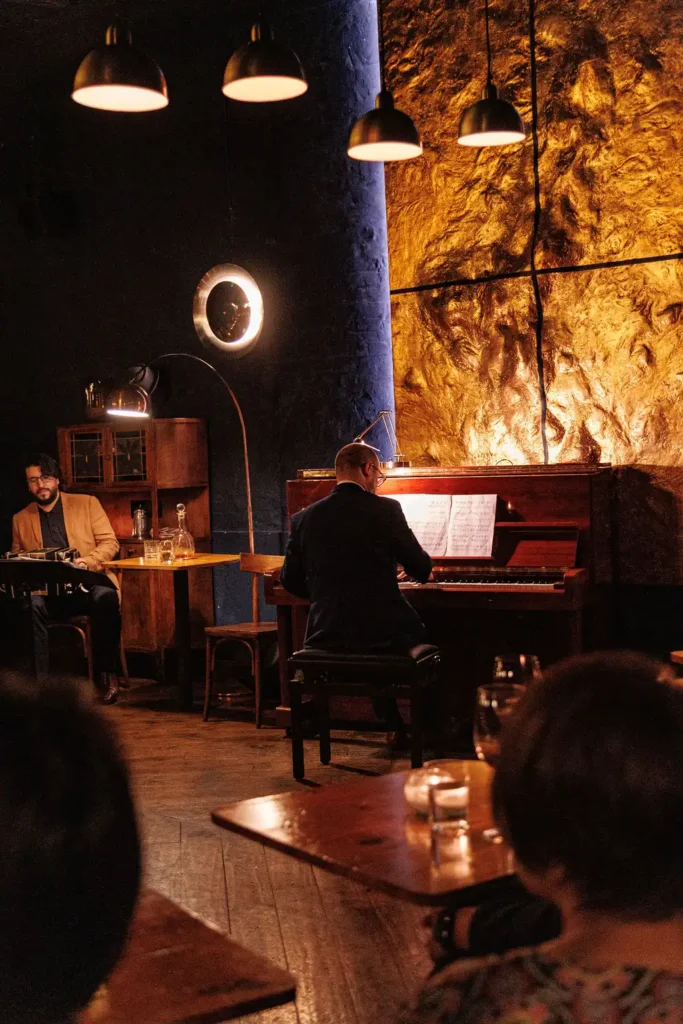
At Secreto Tango Society, we approach the dance from this dual perspective. Our team is composed of local experts, musicians, and professional dancers who have spent years in the milongas of Buenos Aires. We focus on the authentic technicality and sensibility of the dance, stripping away the stage fluff (usually seen in the Big shows) to show you how the dance is truly executed by those who mastered it in its birthplace.
Tango explained: Steps and Codes
1- La Caminada (The Walk)
The Caminada is the heart of tango; in the dance world, we often say that to dance well is, above all, to know how to walk. It is not a standard stroll but a deliberate progression that can be performed forward or laterally. The key to a proper tango walking technique lies in a clear and complete transfer of weight. For a movement to be technically sound, the dancer must move their entire center of gravity over the supporting leg before taking the next step. This is done in constant dialogue with the partner and the music, where the leader signals the “intent” of the walk through the torso before the feet ever leave the floor.
2- El Cruce (The Cross)
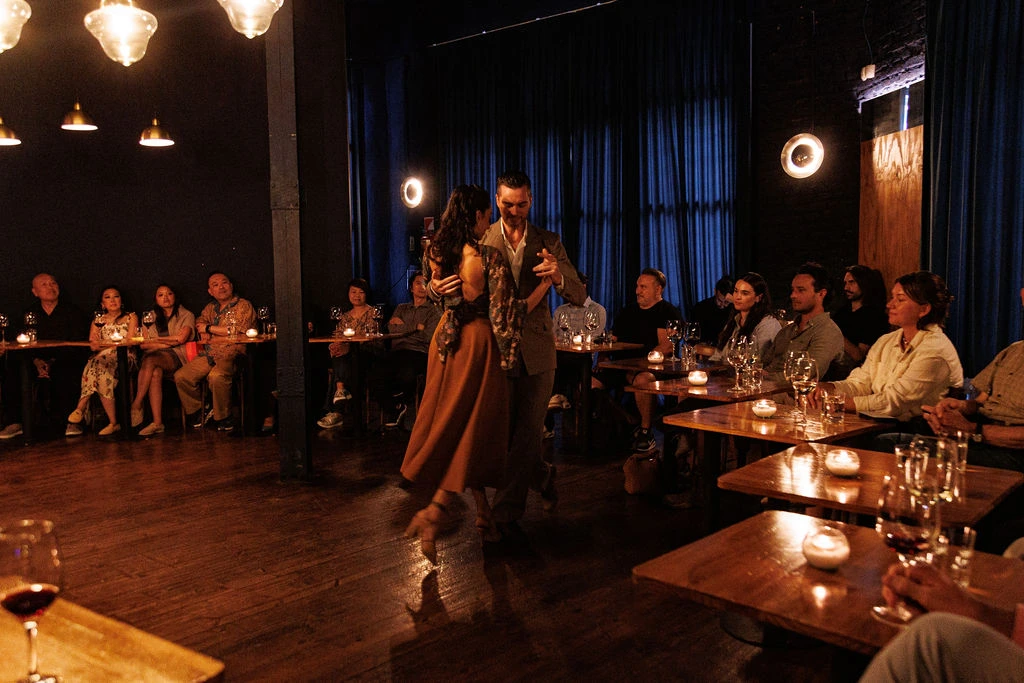
El Cruce is a central element of the basic tango sequence and perhaps the most iconic silhouette of the dance. It occurs at the precise moment when the follower’s left foot is placed directly in front of the right foot, “crossing” the legs. A common technical mistake is thinking the feet do the work; in reality, the cross is marked by a subtle rotation of the leader’s torso, known as dissociation. This rotation provides the technical cue that tells the follower to cross instead of taking another parallel step. Once executed, the tension is released, and the couple returns immediately to the caminada.

3- El Abrazo (The Embrace)
In Argentine tango, the embrace is much more than a simple dance frame; it is the vital connection that allows the couple to move as a single unit. It is built with five points of contact, starting when the woman places her left arm over the man’s shoulder while he wraps his right hand around her waist. The leader’s right hand should be positioned like a “spoon” just below the shoulder blade, with fingers closed to transmit emotion and control. However, the true essence of the Abrazo lies in the torso-to-torso connection. This deep contact of “one body with the other” is what ensures the partners are ready to move in perfect synchronization.
4- La Marca (The Lead)
The Marca is the silent communication that drives the dance, but it is never about “pushing” or “pulling” with the hands. Instead, it is an induction based on moving the center of the body. When the leader moves their center of gravity, the follower responds to that inertia through their shared connection. It is a physical agreement based on physics: the leader proposes a movement through their core, and the follower receives and executes that proposal. This creates a seamless flow where the couple moves as if they were governed by a single nervous system.
5- El Cabeceo
Outside of the physical steps, tango is governed by social codes, and El Cabeceo is the most important one. This is the subtle ritual used to invite someone to dance at a milonga (tango hall). It consists of a discrete exchange of glances from across the room. If both parties are interested in dancing, a slight nod of the head, the cabeceo, confirms the agreement. This allows the invitation to be made and accepted (or politely declined) without the need for words, maintaining the elegant and mysterious atmosphere of the dance floor.
6- La Tanda
The music in a traditional Argentine milonga is never random; it is organized into sets called Tandas. A tanda typically consists of three or four songs of the same style, whether it be Tango, Vals, or Milonga, usually from the same orchestra and era. When you accept an invitation to dance, the social contract implies that you will stay with that partner for the duration of the entire tanda. This allows the couple to develop a deeper connection and settle into the specific “feeling” of that musical set before the cycle ends.
7- La Cortina
To signal the end of a tanda and the beginning of a new cycle, the one in charge of the music plays La Cortina. This is a brief fragment of non-tango music, usually jazz, rock, or pop, that is strictly not for dancing. Its technical function is to clear the dance floor, providing a moment for partners to thank each other and return to their seats. This “reset” allows for a fresh round of cabeceos and ensures that the social energy of the room remains dynamic and inclusive throughout the night.
Secreto Tango Society: Experiencing the Codes
At Secreto Tango Society, we don’t just perform; we live, understand, and share the authentic mechanics of the dance. But we go deeper than the physics of the movement. For us, every step is a concept, and every sequence is a shared moment of surrender. We understand the technical “why,” but we also share the emotional “how”, the raw, sensual energy that defines the Argentine spirit.
Our mission is to offer an immersive and intimate experience that reflects how the dance is truly executed and lived.
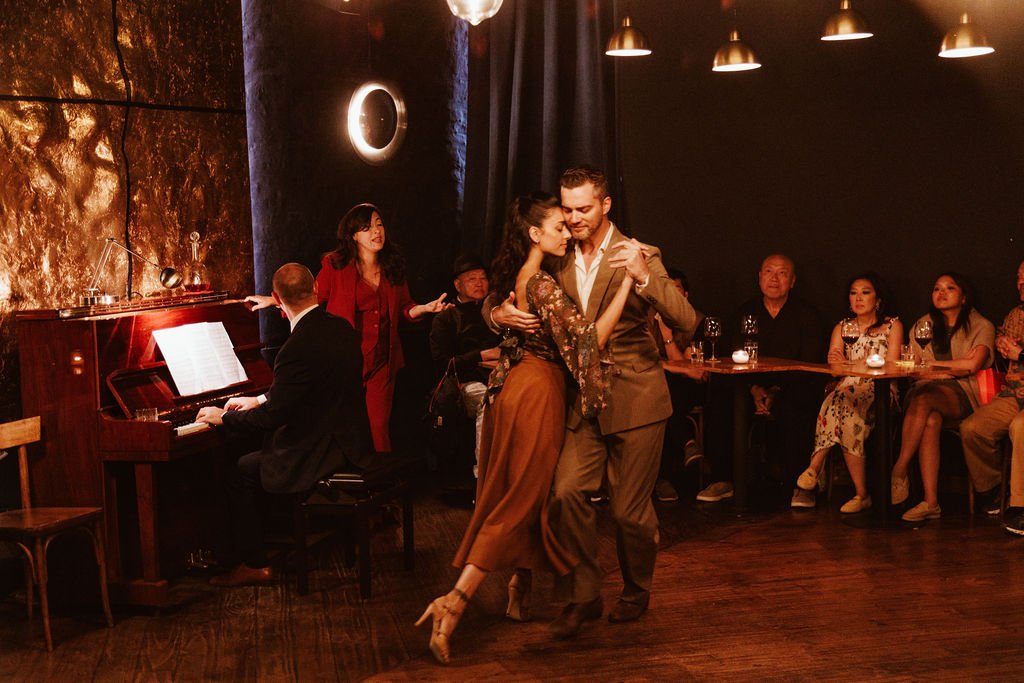
If you are learning how to dance the tango or are a self-taught enthusiast, understanding the technical structure of Argentine tango steps is essential. However, there is no substitute for seeing it in its purest form. There is nothing quite like witnessing a live execution that is not only technically flawless but also emotionally charged with the history and culture of the streets where it was born.
Understanding how to dance the tango is about recognizing that every movement, from the simplest walk to the most complex cross, is part of a larger conversation. Mastering these Argentine tango steps requires time, a lot of weight transfer, and even more heart.
There is no better way to truly understand these concepts we’ve talked about, than seeing them live in an intimate, authentic setting. At Secreto Tango Society, we strip away the big-stage distractions to focus on the raw connection between two people. We invite you to join us in Buenos Aires to see the technical precision of the cruce and the emotional depth of the abrazo just inches away from your seat. It’s not just a show; it’s an invitation into the very soul of our culture.
Keep Exploring the World of Tango
The journey doesn’t end with the steps. To truly grasp why we dance the way we do, you have to understand where this music came from and how it evolved.
Discover the legends and the streets that birthed the dance in our guide to Tango History.
Andi, if you are ready to move from spectator to dancer, check out our resource for Tango Lessons in Buenos Aires.